Showing posts with label culture. Show all posts

Tuesday, 30 April 2013

Hebrew Conjugations Gone Mad – Tech Speak in a Foreign Language

In the tech space in most countries, the English language rules. However, my experiences at work in Israel have really brought to my attention how a language can change through common usage. The following English verbs have crept into the Hebrew lexicon and allow for the full conjugation according to the rules of the Hebrew language. And maybe this is what I find interesting, that not only is the English word used, but it is altered through conjugation. Using the ‘real’ Hebrew word instead of the English word will get you a puzzled look from your conversation partner. Most of these words I have learnt at work, in the hi-tech sector, but many of them are used every day by non-geeks as well…

English Phonetic Hebrew
To configure (eg., a setting on a computer application) L'kanfeg לקנפג
To format L'farmet לפרמט
To filter L'falter לפלטר
SMS essemess אסמס
To interact with someone on Facebook L’fassbeck לפסבק
To be purged (reflexive) L’hitpargej להתפרג’ג'
To be made active L’actev לאקטב
To synchronise L’sunchren לסנקרן

Of course, many English nouns are used as well instead of their Hebrew counterparts. Nouns are a lot less exciting because it seems to be much more acceptable to use the ‘real’ Hebrew word rather than the English one. Additionally, the only ‘change’ they undergo is that they take on the Hebrew form of the plural rather than the English.  The interesting part is guessing whether an English noun becomes masculine or feminine – and this pretty much goes by feel. For example:

English Phonetic Hebrew
user/users user/userim (masculine) יוזר/יוזרים
host/hosts host/hostim (masculine) הוסט/הוסטים
periphery/peripheries peripheria/peripheriot (feminine) פריפריה/פריפריות
function/functions foonktzia/foonktziot (feminine) פונקציה/פונקציות

And then there is my very favourite adjective, found a lot in apartment rental ads, the word is “בילדאין” (bildin), sometimes written as two words “בילד אין” (bild in”, the second word, in Hebrew, is a negation word. So after spending quite a bit of time trying to figure out what the word “bild” meant, I finally realised that just like the term used in English for parking brakes in a car (hand-brakes) has morphed into the amusing “ham-brakes” in Hebrew, “bildin” is basically the English term “built-in” – referring to an oven or something similar in the kitchen. Go figure!

Of course, this is just the tip of the ice-berg, I could go on forever…

Thursday, 4 April 2013

The Israeli

The Israeli is a curious creature. Despite the Israeli being made up of one part of nearly every country in the world, and only a minority of Israelis able to actually call themselves second generation Israeli, this creature has a unique behaviour, which rather than being a mix of all the components making it up, has its own special characteristics. Out in the wild, the following characteristics can be clearly seen, almost without exception:
  • Opinion is as good as fact. If an Israeli heard a piece of information from someone they know, this information becomes fact, even if it flies in the face of logic or truth. An example of how this is embedded in the culture: a private company produces a booklet with the values of all cars of all ages. This has become the reference book when buying and selling a car. The only important thing when setting the sale value of your car, is what the book says. Similarly, negotiations are all centred around the value in the book. Precise percentage discount values are specified for different situations - number of owners, type of previous owners, etc. However, try to argue about the price due to a factor that is not specified in the book and it is a lost cause. The book says so, therefore it is true.
  • Whatever your interaction with one of these specimens  they are doing you a favour, even if it handing over money in return for goods they are selling - by taking your money, they are doing you a favour.
  • Despite being a tipping culture, service oriented Israelis are few and far between, that you sometimes may be forgiven for thinking you are in Australia.
  • When something does not go the way an Israeli wants or expects, he finds it necessary to shout and swear at who/whatever is causing distress. Additionally, the Israeli will try and involve all bystanders within a 50 foot radius in the complaint by shouting a series of rhetorical questions at them, such as; "How can they give us this kind of service?", "I have been waiting here for 30 minutes, how is it acceptable that a bus isn't here?" or "I have never had to do this before, how can they say this? This isn't normal!"
  • After giving him the finger because he honked at you as a result of you obeying the road rules but him not liking it, he pulls up next to you to ask you "why?" He actually listens to your explanation, and then, with only a slight hint of ridicule, wishes you "a very happy holidays from the depth of his heart".
  • Whilst more than happy to fight for his country, in a war, where real deadly weapons are used, the Israeli is shit-scared that somehow if he lets you off the train before he pushes himself onto the train, the train might leave without him. Although this extends to all forms of public transport, it is most evident on the trains.
And like all Israeli documents, the following disclaimer applies: All references to males in this document apply equally to females. Similarly, all references in the singular apply equally in the plural.

Thursday, 14 March 2013

Modern, Yet Behind The Times

There is no doubt that Israel is one of the most technologically advanced countries in the world. This is what the statistics say. Silicon Wadi, the concentration of hi-tech start-ups along the coastal strip from Tel-Aviv up to Haifa is second only to Silicon Valley (and actually beats Silicon Valley in some statistics). Take start-ups out of the equation, and you still have the dozens of huge international companies who have chosen to set up one of their few offices outside the USA, in Israel. Of course, the cynical amongst us (me included, at times), would argue that one of the main reasons for this is the relatively low cost of labour here compared to the high productivity - I wouldn't be surprised if Israel tops the world 'productivity / labour cost' list. However, when it comes to day to day interaction with this country, one could be forgiven for thinking that it is only just emerging from the middle ages - and I'm sure some would argue that this is because people have bigger fish to fry here than to worry about the small stuff, but I would argue that it's because technology companies are so focused on the big money, that it's much more lucrative simply to export to larger markets, than to try and work within the Israeli market. So what exactly am I talking about?

Saturday, 29 December 2012

A Little Bit Like Africa

IMG_20121229_112919
I have decided that there are a lot of similarities between living in Israel and living in Senegal. In many ways Israel is a particularly technologically advanced nation, but in many ways, there is a slightly less modern feel about it. However, unlike Senegal, I like this less modern feel – it has character and energy.

Haifa is already growing on me. A city where Jews, Arabs, Druze and Baha’i live in relative harmony, it feels very much a multicultural city. I hear Arabic as much as I hear Russian. I don’t feel uncomfortable at all when I walk past an ultra-orthodox Jew on the one side of the street walking his son to synagogue, and see a Muslim on the other side on his way to the Mosque. My neighbours speak Arabic, yet half the doors in the corridor have mezuzot on them. Of course, some of the benefits of this multicultural city seem very selfish – I have the option of eating kosher if I want to, but I am also free to go shopping on Saturday. On the other hand, Haifa feels very much like a large town, rather than a city. There is no significant CBD with lots of skyscrapers, people dawdle (except when driving) and the place really isn’t so polluted (but perhaps I’m just comparing to Dakar…).

IMG_20121229_113023

Today I went to the local shuk in Wadi Nisnas, the majority Arab neighbourhood bordering on my new home in downtown Haifa. Not only was it open on Saturday, it was thriving with people, guarded at all entrances, something which didn't feature on Friday. And as I am still getting used to, I walk past the security checkpoint and casually get asked whether I am armed, in the same manner as someone else might ask me for the time. I walk through the crowds, notice the children’s entertainment, and the band on the roof playing what sounds like a Yiddish twist on Michael Jackson’s Billy Jean. I go in with a shopping list – a new apartment needs a lot of basics. However, a few hundred shekels later, I leave primarily with lots of Middle Eastern goodies. Halva in multiple varieties, more baklava than I can possibly eat (though that won’t stop me trying), fresh pita, chocolate croissants, rougelach (similar to a chocolate croissant, but the chocolate is rolled into it rather than put as a filling, and then it is topped with icing sugar), a half kilo back of za’atar (my favourite spice of all time which seems to be sorely lacking in many countries), and of course, a few things I actually needed…

Monday, 22 October 2012

Saly - not quite Scarborough Beach

The local 'Picaso' taking my purchase (bargained from 60,000
down to 20,000 CFA) off the frame.
Saly is one of the resort towns of Senegal (the other one being Cap Skirring). It is a around 80km South of Dakar (which means anywhere from 50 minutes to 2.5 hours driving) and serves weekend holiday makers as well as Europeans on package holidays. It has sun, beaches, and clubs. My reason for going: the beaches. I wanted to get away from Dakar for a weekend, relax on the beach which would hopefully be nicer than the ones in Dakar, and just enjoy a quite weekend. Well, on Senegalese standards, it lived up to these expectations. Therefore, if you're in Senegal, it makes for a nice getaway - though I certainly couldn't recommend making an effort to specifically come here from another country - that, is something I don't get...

Oh, and don't watch the video below if you're planning on having fish for dinner...

Sunday, 21 October 2012

A Cultural Divide

Since it would obviously be politically incorrect of me, and perhaps even racist by some, to generalise about negative aspects of a group of people based on their culture, I figured, since today was full of great examples, to write a post about the massive cultural divide between myself and 2 particular people – they happened to be taxi drivers in Senegal (although the latter, in a sense, drove a car and accepted payment for the ride, I’m not sure if he really was a taxi driver…) In case someone happens to misconstrue this as a generalisation about Senegalese (heaven forbid), I will throw in an example of the cultural divide between myself and a certain aspect of bureaucracy – the other person happens to be an Indian.
IMG_20121019_170507
Stuck in Friday arvo traffic - downtown Dakar

Taxi!

So after deciding to take a weekend break at the seaside resort of Saly, I flag down a taxi after work to take me to the Gare Routiere, from where I will catch my sept-place taxi to Saly. The conversation with the taxi driver, before I get in, and following the standard pleasantries, goes something like this (I have translated in a way that I assume I would sound in French).
Me: I would like to go to the Gare Routiere. How much?
Driver: blah blah blah blah. Gare Hotel blah blah blah.
Me: No. Gare Routiere (this time, pronounced differently, just in case I got it wrong first time).
Driver: Blah blah blah. Gare blah blah. City blah blah?
Me: Not city. Near Point E. Before Place de l’Indepdance. I want to go to Saly. Sept-place taxi. Gare Routiere.
Driver: Ah, Point E. Ok.
Me: No, NEAR Point E. But Not Point E. Before Place de l’Independance.
Driver: Ah, Place de l’independance?

Sunday, 26 August 2012

Entrepreneurship in Senegal

IMG_0277
Not 'the' beach, this one is further down the road on the Westernmost
point of the continent
After visiting the beach yesterday afternoon for a bit of R&R, my interaction with the local entrepreneur got me thinking about about entrepreneurship in Senegal. Something that exists on a completely different level to the capitalist entrepreneurship I am used do. Of course that does exist here, but to an extremely limited extent. Here is my experience, at my local beach – I go there because it is a 10 minute walk away, and I’m not actually sure there are any other beaches in a reasonable walking distance (I use the Australian definition of a beach here – where land meets ocean in the form of gently sloping soft sand into the water – some rocks are acceptable).

I sit down on the sand, specifically not taking advantage of one of the half broken umbrellas or partially torn up straw mats. Within seconds, I am approached by a hustler, calling me mon ami and asking for 2,000 CFA! Although this at some point in the conversation changed to 1,000 CFA, and I’m sure is different for every person at the beach, I wasn’t up for it. I figured this is a good opportunity to practice the little French I know, since the gentleman does not speak English. “Why?” I ask. He explains. I have little idea what he’s saying. We go back and forth, with half of the conversation being me telling him that I don’t understand or him telling me that he doesn’t understand English. My argument (armed with knowledge I gained from my colleagues) is that this is a public beach, I am not using any of his ‘equipment’, so why do I need to pay? His argument, I think, is that just like I have a job, he has a job, and it is related to the beach. It seems as though he is telling me that he cleans the beach and makes it look presentable. Admittedly, the beach does look a 100 times nicer than most public spots in Dakar. There is very little rubbish there, the sand and rocks are clearly separated in a way which didn’t occur naturally. Still, I argue – I a coming here to read my book and swim. If I use his services, I will pay. After 15 minutes he decides to leave me and give me free passage.

Sunday, 29 July 2012

258km in 6 hours - The Road to Saint Louis

One restored building, and its mirror image across the street, 'about' to be restored
No, I haven't made it over to Missouri, USA. I have just headed up to a town which provides a strong reminder of the French presence in the area. Both because the town was named after the French king at the time (but seriously, to add 'Saint' in front, does seem a little obnoxious), and also because of the fact that Saint Louis served as the capital of French West Africa for over 2 centuries. The town, another one of Senegal's UNESCO World Heritage Listed sites is part crumbling to bits, and part remnants of its colonial past.
Above: Silting from the artificial break in the sand banks is very evident.
Below: the locals enjoying some colonial shade.

Sunday, 22 July 2012

Going Colonial in Gorée

I have quickly realised that my blog entries about touristy things are going to be extremely different to what I'm used to writing. Primarily because tourism (which for me - is more or less doing or seeing something new in a different place) is totally different to what it is in Europe. Essentially, it is a lot more limited by that definition. There aren't that many places in Senegal that I would say I would want to go to from a tourist point of view (of course, this is solely my opinion). Either that, or my enthusiasm for travelling has waned a bit (possible, but less likely). Within Dakar, I don't have that much enthusiasm to go and 'see' things, but I guess that's because the few cultural sites are all in French, and there isn't really a heck of a lot of 'beauty' around. Nice architecture is lacking, as is places of natural beauty.
Enter two things to do. SCUBA diving, and visiting Gorée Island...

Saturday, 14 July 2012

The Kindness of Senegalese (and work..)

The friendliness and generousity of people in Senegal cannot go unnoticed. Unfortuntaely, with my limited (or should I say, lack of) French, the only appreciation I seem to be able to show is "merci", or the occassional "merci beaucoup". It just doesn't seem to do it justice.

Thursday, 5 July 2012

Musings on Dakar - Part 1 (most likely...)

Welcome to Léopold Sédar Senghor  (Dakar) International Airport 
I have only been here a short time, but I have already noticed so many things that stick out to me. Some of them stick out because I have simply been transformed to a different climate, different culture, different language and different life. Others though, simply do not have explanations because in any context, they simply do not make sense. In no particular order, this is my list of impressions of this hot country of which I have only touched upon...
  • The unofficial taxi driver coalition in Dakar believes that if enough of their members honk at you, you will eventually get in one of their taxis and pay for a ride.
  • In terms of equal standards, accommodation costs are slightly higher than Scadinavia, yet taxi rides are about one-twentieth the cost, even though the cost of fuel is roughly the same (on the other hand, the standard of the taxis themselves, can't really be compared...)
  • It is nigh on impossible to find a self-service laundrette. But there are plenty of "pressing" shops that will clean your clothes (I have a feeling they actually dry-clean...) at a handsome cost per item (a load of basic washing just cost me 16,800 CFA / $33)
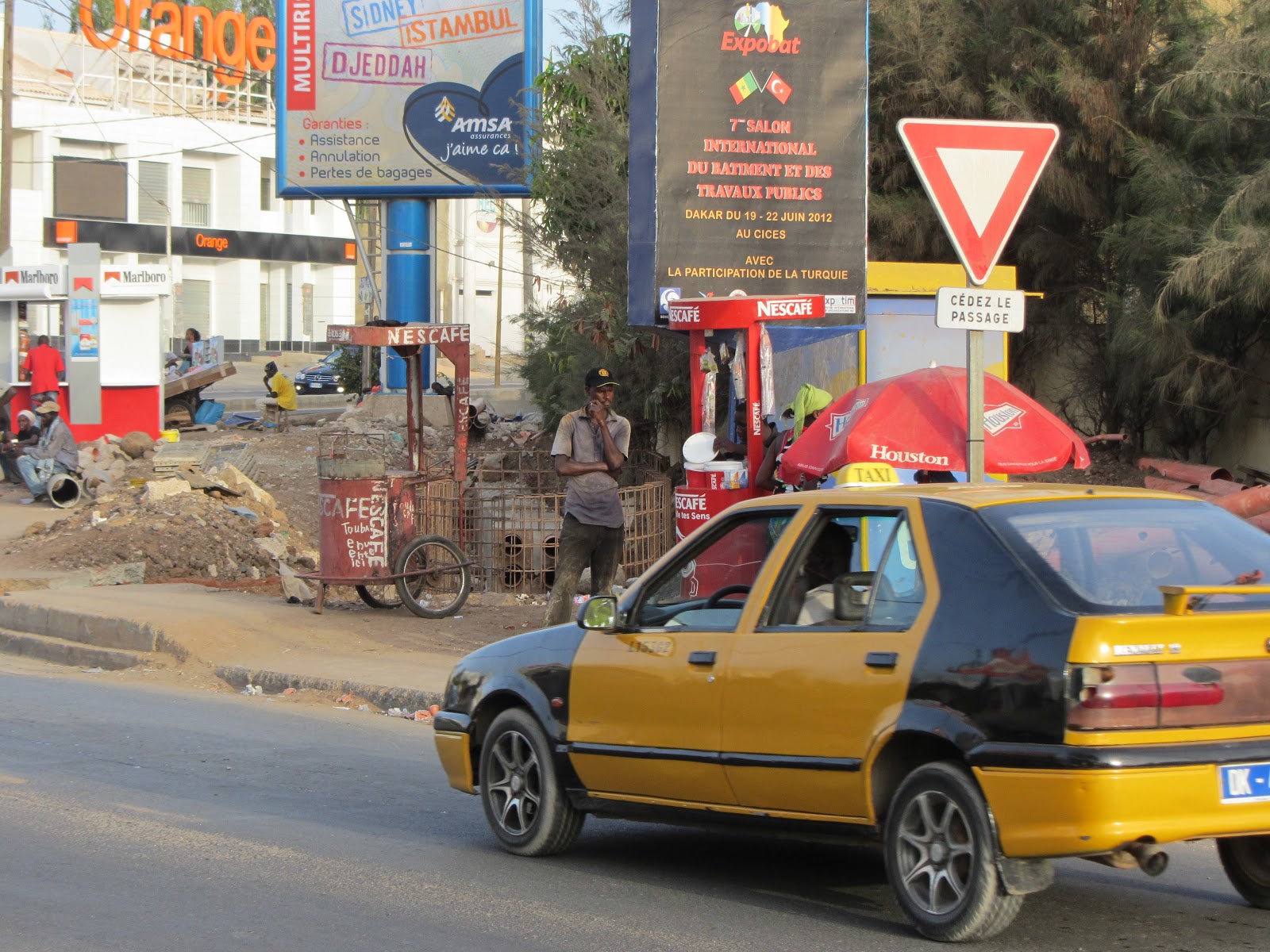
A busy round-a-bout with 3 Nescafe vendors (2 seen here, partly
blocked by a ubiquitous yellow taxi)
  • Instant Nescafe from a street-seller in a tiny plastic cup is the height of coffee culture, and can be found on every street corner.
  • Forget Japanese, European and American cars, Iranian and Indian cars rule the roads here!
  • Forget BP or Caltex, here we have OilLibya!
  • Like most non Anglo-Saxon Western coutries, the people are some of the most warm, welcoming and genuinely friendly people ever. Spend a day driving a new colleague aroundn to help him find an apartment? No problems. Invite a relative stranger into your house for a meal? Of ourse. Whilst overfriendliness tends to raise alarm bells with me, the worst thing that is likely to happen here as a result is daylight robbery by the street-seller or taxi driver.

Friday, 29 June 2012

Bumper Cars in Dakar

Today I got a ride to my hotel with a Japanese woman in the office who happened to be leaving at the same time as me and heading in the same direction. When I mentioned that I thought she was brave to drive here, she told me that it's not so bad, and I only need to go to downtown to see 'bad' drivers. Wow! I've seen good-bad drivers (Israel), crazy-bad drivers (Bangkok), and now, scary-bad drivers (Dakar). There was certainly no need for the humanitarian aid agency I work for to have a rule about no driving when on deployment, there is no chance in hell I would chance it here!

Wednesday, 23 May 2012

A Divided City No Longer

Pariser Platz - named so many years ago to piss off the French
I have always been amazed by the concept of war, especially, past wars. Mostly, because they don't make sense, but also because countries tend to behave in such ways which make even less sense. Even equating countries with toddlers doesn't quite explain things. The results of WWII are evident throughout Germany,  and although Berlin nowadays acts like one city, it is quite clear from how it looks that there are two sides to the coin.


A Wandering Jew in Berlin

Walking along the East Side Gallery - a remaining part of the Wall
With tens of thousands of Jews living in Berlin now, I wonder to myself a little bit, "why?". While I wonder that, I think others may wonder why Jews even want to visit the city. However, Berlin is, on the surface at least, an extremely multicultural city now with people of all different sorts of colours and backgrounds roaming around. On the one hand, it's hard to imagine the horrors of 20th century, but on the other hand, walking through Berlin, it's hard to forget them too.

Sunday, 15 January 2012

Hamburgers

The engineer in me was totally fascinated
by the train being able to roll onto the ferry
for the crossing to Germany.

As every intelligent person knows, Hamburger refers not only to the delicious meal, but to a person who comes from the German city of Hamburg. In fact, in adjective form, it also refers to anything of Hamburg origin. Unfortunately, when one does not understand German and therefore cannot understand the words that follow 'Hamburger' on a restaurant menu, it is only natural to assume the item is something along the lines of two all beef patties special cheese lettuce onions on a sesame seed bun. Well, one is wrong.

Tuesday, 22 November 2011

Dear Denmark

Dear Denmark,

It is time to be 100% open with you - I'm not sure this relationship is for life. That's the short, blunt, story. The long story though, is that I have not given up yet, and I want you to understand what might happen and why...

Thursday, 17 November 2011

Diving the Red Sea

The Negev - like the Australian outback, but with hills and cliffs!
My three day trip to Eilat was as much about relaxing at home, as it was finally getting to dive in the Red Sea. With 3 other countries in clear sight, one still feels as if one is clearly in Israel, and not necessarily some international resort. Of course there is no shortage of foreign languages being spoken, but Hebrew still dominates (and Russian isn't that far behind). I don't remember Eilat that much from my previous visit around 20 years ago, just bits and pieces. But I'm sure it has grown and changed quite a lot - the bits I do remember, were the same.

Sunday, 14 August 2011

Viva la Revolucion

Traditional dress
Koprivshtitsa a beautiful historic town in Central Bulgaria and was the scene for our second day trip. As there was also going to be a kind of folk festival happening in town, we thought it would be a good time to visit. Although the town was in fact rather beautiful and a fascinating place from an historical perspective, the performances at the festival left a little to be desired. Unfortunately, the singing, which was very poorly amplified by the loudspeakers was pretty ear piercing. The dancing though, at least was something a bit different and got my attention for a few minutes!


Friday, 12 August 2011

Popping Over to Plovdiv


I managed to fit in two lovely day trips during my short stay in Bulgaria (or rather, two day trips were fitted in for me).

The first was to a city in the centre of the country called Plovdiv - described as one of the most beautiful cities in Bulgaria. Well, to be perfectly blunt, with Sofia as my reference point, it wasn't going to be hard to beat. Turns out, Plovdiv really is a rather beautiful city with its own special character, and an amazing old city that has a well preserved Roman and Turkish influenced architectural side to it. Enough for a day trip, perhaps even an overnight trip - but definitely a city you can spend a few hours wandering around aimlessly in...


Making A Jewish Mother Proud - Bulgarian Style

This typical train station is indicative of my overall impression of
Communist buildings in Bulgaria...
Well, it seems like Jewish mothers have some competition - Bulgarians! Never would my mother be so proud of the way someone extended hospitality towards me and worried about me so much more than one would think possible, than with my friend and guide in Bulgaria.

Mineral water springs in the centre of the city - the locals are constantly
filling up water bottles to take home so they can enjoy the good minerals.
The warnings I got prior to and during my trip made me think I was entering the third world: Don't cross the street when the green man appears without first checking for cars (only to have my guide cross at a red light instead). Don't go north of this street, it's very dangerous. I wasn't allowed to walk around by myself at night. Warned about getting ripped off left, right and centre. Concerned that there were lots of ugly buildings around. Worried that I would be too busy and get tired. Concerned that there was more to see and do. Very tiring. But wow, what an absolute pleasure! My experience in Bulgaria could not have been better, and despite all the bad things I had heard from my friend, the country was a pleasant surprise for me.
Yet another great photo, thanks to my guide & photographer. This is the old mineral bath house